Dear Editor:
As Parsippany considers its township budget for 2026, an observer of recent Town Council meetings can conclude many residents are decidedly against a substantial tax increase. Among the objections raised at various Town Council meetings is the lack of context provided by the new Administration. By presenting only the current year, with no comparative or historical data, little to no context was provided to the public. The information below is an attempt to provide data that is available but has been missing from Town Council meetings that the public may find useful.
In 2022, for the 2022 budget year, a 14.56% local property tax increase was submitted by the town. Note that all budget numbers provided for the town are for municipal property taxes and library tax and most closely present the tax burden borne by residential taxpayers. In 2022 the country was still in the middle of the covid lockdown which included the beginning of the move to remote work, reducing demand for office space along with less tax revenue from commercial properties, which necessitated an increase in residential property tax revenue.
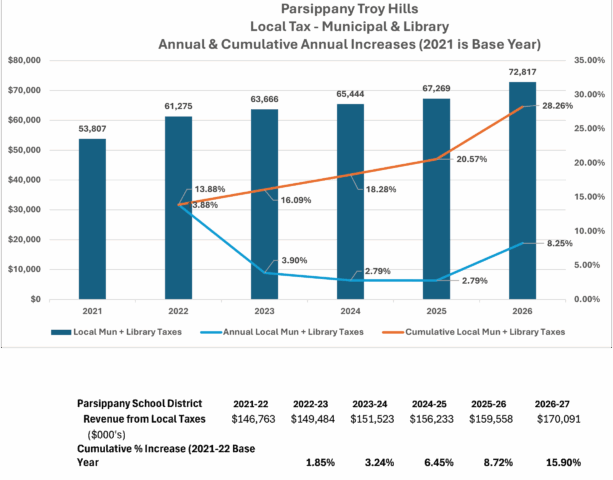
For the next 3 years, 2023 to 2025, the annual increases in the local tax levy for the town were modest, ranging between 2.5% and 4%, especially given the inflationary environment at the time. But the 4-year cumulative tax increase was 20%. The graph includes a cumulative increase in line with 2021 as the base year. The cumulative increase for the 4 years of 2022 to 2025 was 20.84%, an average of 5.21% per year. With the current proposed increase of 8.25%, the total increase for 5 years is over 28%.
For further context, consider the school district budget over the last few years. One might expect that local tax revenue for schools has increased at a higher rate than for the town. That expectation turns out to be wrong. For the previous four years, the cumulative increase in local taxes for the school district was 8.72%. A big reason for the slight increase is the state mandated 2% maximum annual increase in the local tax levy. And with the increase forecast for the 2026-2027 budget year, the cumulative increase is 15.9%, far lower than the 28.26% cumulative increase for the same period for the town.
There is no question that inflation was a factor for the town and the increase in the budget barely outpaced inflation. However, the school district was also impacted by inflation. While it had a mandate from the state to not increase property taxes by more than 2% per year, it managed to remain below the inflation rate by making hard choices and imposing cuts in spending such as the reduction of 14 staff in the 2025-2026 budget year.
Given the town has increased local property tax revenue over the last 5 years at a much higher rate than the school district, the administration may want to consider ways to lower its proposed increase. One way would be to impose a hiring freeze, including eliminating new hires that occurred early in the year, as reported by the administration. Those hires should not have occurred until there was an adequate chance to ascertain the financial condition of the town. The proposed town increase plus the increase by the school district impose a significant financial burden on the citizens of Parsippany. As noted above, the town has imposed much higher percentage increases in taxes over the last 5 years compared to the school district. Given the school district faces an unprecedented increase in health insurance costs, it is the town’s turn to impose budget cuts.
Jack Raia