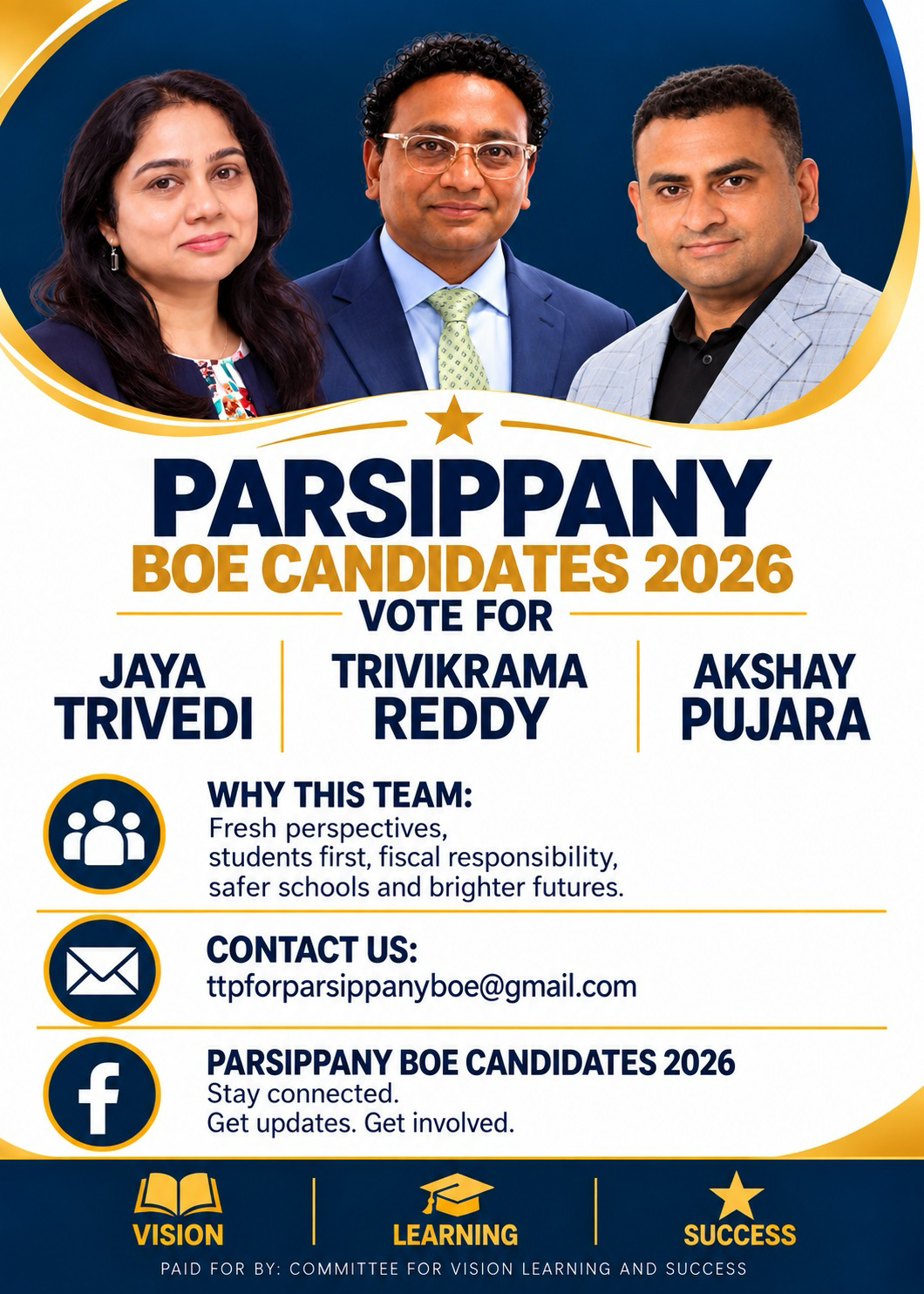
Parsippany Focus submitted identical questions to each Parsippany Board of Education candidate. We print all answers verbatim.
1. Board Meeting Attendance
How many Parsippany Board of Education meetings have you attended in person during the past 12 months? What have you learned from attending?
For the past 12 years, my wife, Suneetha, and I have proudly called Parsippany home and have raised our two children, Nayanasree and Keyura, in the Parsippany school system. As a parent, I have seen firsthand the positive impact our schools have on students and families. Professionally, I am a Senior Staff Engineer with more than 20 years of experience in the medical technology industry, hold a Ph.D. in Mechanical Engineering and an MBA, and am the inventor or co-inventor of 15 engineering patents. I also serve as an Adjunct Professor at NJIT, where I have taught and mentored students for the past eight years. These experiences have strengthened my commitment to education, community service, and helping students achieve their full potential.
Over the past year, I have attended and actively participated in numerous Parsippany Board of Education meetings, where I raised questions about student mental health, school-university partnerships, and improving communication with families regarding school readiness.
These meetings reinforced the importance of balancing educational excellence with fiscal responsibility amid challenges such as state aid uncertainty, rising transportation costs, facility maintenance needs, and growing enrollment. I also heard a clear desire from residents for greater transparency in how decisions are made and how taxpayer dollars are spent.
One concern I observed was the relatively low level of community participation at Board meetings. I believe we must do more to engage residents, improve communication, and encourage greater public involvement. As a Board of Education member, I will work to strengthen transparency, enhance community engagement, and support long-term planning that benefits our students, families, and taxpayers.
The experience of attending these meetings has reinforced my belief that strong schools are built through thoughtful planning, open communication, community involvement, and a shared commitment to student success
2. Understanding the Role
What is the difference between governing the school district and running it? What are three things that should be handled by the superintendent or administration rather than individual Board members?
A successful Board of Education member serves as a steward of taxpayer resources and an advocate for student success by focusing on policy, strategic planning, and accountability. The Board’s role is to establish the district’s vision, approve budgets, set policies, evaluate the Superintendent, and ensure that decisions align with the best interests of students, families, and taxpayers.
The Superintendent and administration are responsible for carrying out that vision through the daily management of schools, personnel, transportation, curriculum implementation, and district operations.
I believe effective governance requires maintaining a clear distinction between oversight and administration. Board members should focus on setting direction, asking thoughtful questions, ensuring transparency, monitoring outcomes, and engaging the community, while empowering district leadership to manage day-to-day operations. This partnership is essential to delivering educational excellence while remaining fiscally responsible.
3. Three Changes
What are three changes or improvements you would like to see in the district, and why?
1. Stronger Long-Term Financial Planning
As an engineer, inventor, and business professional, I have spent my career solving complex problems through data-driven planning and risk management. I would like to see the district adopt a long-term financial strategy that aligns enrollment growth, staffing needs, transportation, facilities, and capital investments. Proactive planning will help maintain educational excellence while protecting taxpayers from unexpected financial challenges.
2. Greater Transparency and Community Engagement
I believe residents deserve clear, accessible information about district finances, priorities, and outcomes. The district should expand communication through easy-to-understand budget summaries, performance dashboards, and regular community updates. Stronger transparency builds trust, increases public participation, and strengthens the partnership between schools, families, and taxpayers.
3. Expanded Student Opportunities and Career Readiness
As an NJIT Adjunct Professor, educator, and mentor, I have seen firsthand that students succeed when they are given multiple pathways to achieve their goals. I would like to expand STEM programs, career and technical education (CTE), skilled trade pathways, internships, research opportunities, and industry partnerships. Every student should have access to opportunities that prepare them for college, technical certifications, apprenticeships, skilled trades, military service, or the workforce.
As a parent, educator, engineer, and community servant, my goal is simple: ensure Parsippany students continue to receive an excellent education while preparing them for the opportunities and challenges of tomorrow.
4. Budget & Taxes
The district is facing significant financial challenges. What areas of the budget deserve closer review, and what would you protect from cuts?
The district faces increasing financial pressures from rising operational costs, enrollment growth, facility needs, and uncertainty in state aid. As a Board member, I would support a careful review of administrative expenses, outside consulting contracts, procurement practices, energy usage, transportation costs, and other operational efficiencies to ensure taxpayer dollars are used effectively.
At the same time, I believe we must protect the programs and services that directly impact students. My priorities would be preserving strong classroom instruction, special education services, school safety, mental health support, academic intervention programs, and opportunities that prepare students for college, careers, and skilled trades.
My approach would be to focus on efficiency, accountability, and long-term planning while minimizing the impact on students and maintaining the high educational standards that Parsippany families expect.
5. Long-Term Planning
What should the Board do now to prepare for future budgets and avoid addressing financial problems one year at a time?
Parsippany must move from addressing challenges one budget cycle at a time to implementing a comprehensive three-to-five-year financial and strategic plan. This plan should incorporate enrollment projections, facility capacity and overcrowding assessments, staffing needs, state funding scenarios, and long-term capital improvement priorities.
As an engineering professional, I have spent my career using data, forecasting, and strategic planning to solve complex problems before they become crises. I believe the Board should apply the same disciplined approach to managing our school district. Proactive planning will help us make informed decisions, protect educational quality, use taxpayer dollars responsibly, and ensure our schools are prepared for future growth and changing community needs.
6. Enrollment & Development
How should the district prepare for changing enrollment and new housing when planning class sizes, staffing, transportation, and school capacity?
Parsippany’s growth and redevelopment present both opportunities and challenges for our school district. The Board must take a proactive approach by working closely with township officials, regularly reviewing enrollment projections, monitoring school capacity, and planning ahead for staffing, transportation, and facility needs before overcrowding becomes a problem.
As a Senior Staff Engineer, I have spent my career using data, forecasting, and long-term planning to help organizations prepare for future growth and make informed decisions. As an NJIT adjunct professor, I also understand the importance of creating learning environments where every student has the resources and attention needed to succeed. My experience in both industry and education has taught me that the best results come from planning ahead rather than reacting after challenges arise.
As a parent of children who have benefited from Parsippany schools, I want every student to have access to high-quality educational opportunities, manageable class sizes, and a supportive learning environment. By planning thoughtfully today, we can accommodate future growth while preserving the educational excellence that makes Parsippany a great place to live, learn, and raise a family.
7. PILOTs & Township Cooperation
What role should the Board of Education have in discussions with the Township about new development and PILOT agreements that may affect the schools?
As Parsippany continues to grow through redevelopment and new housing projects, the Board of Education should be an active voice in discussions that may impact our schools. The Board should work collaboratively with township leaders, provide data-driven projections on enrollment and facility capacity, and advocate for transparency regarding the educational and financial impacts of major developments and PILOT agreements.
As a Senior Staff Engineer, my career has focused on evaluating long-term impacts, managing complex projects, and making data-driven decisions. I believe the same approach is needed when assessing how new development may affect class sizes, staffing, transportation, school capacity, and taxpayer resources. Good planning begins with understanding future demand and preparing accordingly.
As a parent, educator, and NJIT adjunct professor who has been recognized by students for excellence in teaching, I understand that every decision ultimately affects our children and their learning environment. My goal is to ensure that growth is managed responsibly so that students continue to receive the high-quality education they deserve while protecting taxpayers from unforeseen costs.
8. Student Achievement
How should the Board measure student success? What areas of student achievement or opportunity need more attention?
Student success cannot be measured by test scores alone. It should be evaluated through academic achievement, student growth, graduation rates, attendance, extracurricular involvement, college and career readiness, and most importantly, student well-being. Every student should have the opportunity to discover their strengths and reach their full potential.
As an NJIT Adjunct Professor and Senior Staff Engineer, I have dedicated my career to helping students and young professionals succeed. My 4.9/5.0 Rate My Professor rating and strong student feedback reflect my commitment to mentoring, guiding, and preparing students for their future careers. I would bring that same student-centered philosophy to the Board of Education.
As a new Board member, I would bring a fresh perspective focused on expanding opportunities for all students. I would like to see continued investment in STEM education, career and technical education (CTE), skilled trade pathways, internships, mental health support, advanced coursework, and programs that help close achievement gaps. Not every student follows the same path after graduation, and our schools should support students pursuing college, technical certifications, apprenticeships, military service, skilled trades, or direct entry into the workforce.
As a parent, educator, and community member, I believe our responsibility is to ensure that every student feels supported, challenged, and prepared for success. My goal is to help create an environment where all students have the tools, opportunities, and confidence to thrive in whatever path they choose.
Student achievement is not simply measured by where students are today, but by how well we prepare them for tomorrow.
Question 9: Difficult Decisions
When the Board must make difficult decisions involving taxes, staffing, class sizes, programs, or facilities, what information should guide those decisions?
Difficult decisions should be guided by facts, transparency, and a clear focus on student outcomes. When evaluating issues involving taxes, staffing, programs, or facilities, I would consider educational impact, financial sustainability, enrollment trends, community input, and long-term consequences rather than short-term fixes.
As a new Board member, I would bring a fresh perspective that encourages thoughtful discussion, data-driven decision-making, and open communication with residents. While there may not always be easy answers, I believe decisions should be made with both students and taxpayers in mind.
10. Transparency & Accountability
What information should the district provide so taxpayers can better understand how their money is being spent and what results it is producing?
Taxpayers deserve clear, timely, and easy-to-understand information about how their money is being spent and the results it is producing. I support plain-language budget summaries, annual performance dashboards, updates on district goals, facility and capital project reports, enrollment trends, and convenient online access to financial information.
One observation I’ve made while attending Board meetings is that community participation is often limited. I believe the district can do more to communicate with residents, increase awareness of important issues, and make information more accessible. When people understand how decisions are made and how resources support student success, trust in the district grows.
As a new Board member, I would bring a fresh perspective focused on transparency, accountability, and community engagement. My goal is to help ensure that residents feel informed, heard, and confident that taxpayer dollars are being invested wisely to support student achievement.
Transparency builds trust, and trust creates stronger schools and a stronger community.
11. Experience & Community Service
What professional experience and community service during the past five years have prepared you to serve on the Board of Education?
I bring a unique combination of professional leadership, educational experience, and community service to the Board of Education.
For more than 20 years, I have worked in the medical technology industry as a Senior Staff Engineer, leading complex projects, managing budgets, evaluating risks, and collaborating with diverse teams to solve challenging problems. I hold a Ph.D. in Mechanical Engineering and an MBA, am an inventor with 15 patents, and have been recognized with global awards for innovation and leadership in healthcare technology.
For the past eight years, I have also served as an Adjunct Professor at NJIT, mentoring and teaching future engineers. I have been nominated multiple times for NJIT’s Excellence in Teaching Award and have earned a 4.9/5.0 student rating. The most rewarding part of teaching has been helping students develop the skills, confidence, and direction needed to succeed in their careers.
Beyond my professional and academic work, I have been actively involved in community service and educational outreach, including mentoring students, supporting educational initiatives, and leading charitable and humanitarian projects. I was honored to receive BD’s inaugural Community Excellence Award for global community impact, including efforts that helped bring clean drinking water to underserved communities.
As a Parsippany resident and parent with children who have benefited from our schools, I understand both the opportunities and challenges facing our district. I believe my experience in strategic planning, financial stewardship, education, innovation, and community service has prepared me to be a thoughtful, collaborative, and effective advocate for students, families, and taxpayers.
My commitment is simple: bring data-driven leadership, educational insight, and a passion for service to help ensure every Parsippany student has the opportunity to succeed.