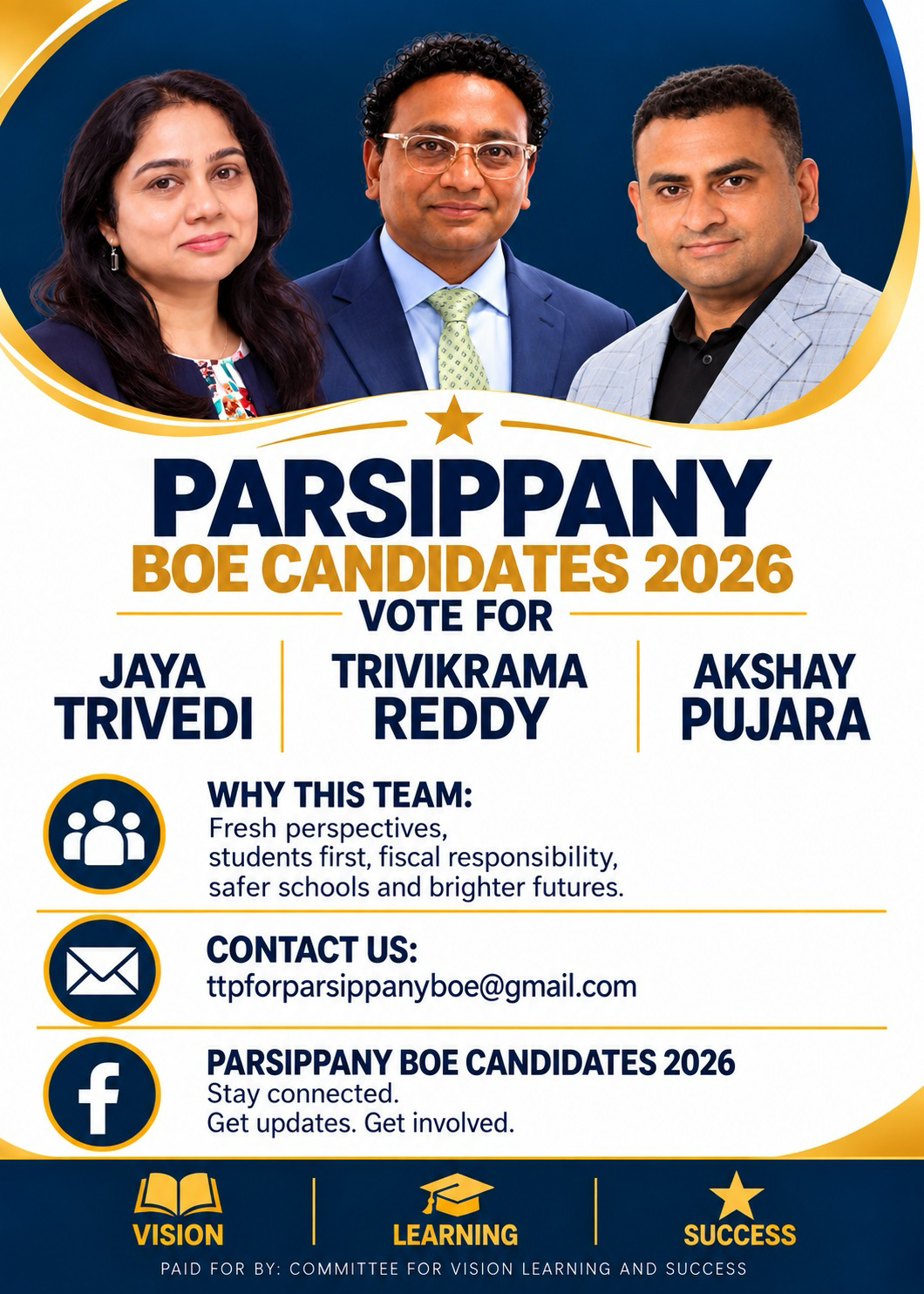
Parsippany Focus submitted identical questions to each Parsippany Board of Education candidate. We print all answers verbatim.
1. Board Meeting Attendance
How many Parsippany Board of Education meetings have you attended in person during the past 12 months? What have you learned from attending?
I have attended five Parsippany-Troy Hills Board of Education meetings in person during the past 12 months and watched online recordings of many additional meetings as my schedule permitted.
I also attended a Board Member retreat open to current Board members and members of the public, where the New Jersey School Boards Association presented on the roles and responsibilities of Board members and the superintendent. It helped clarify where governance ends and administration begins, and how the two can work effectively together.
These experiences have given me a firsthand look at issues involving finances, staffing, student programs, facilities, and operations.
What I have learned is that good Board service starts with listening. It means coming prepared, asking thoughtful questions, understanding the facts, and recognizing that important decisions rarely have simple answers.
As a first-time candidate, I know there is more for me to learn. I believe that is part of responsible Board service: listen, learn, and work collaboratively.
2. Understanding the Role
What is the difference between governing the school district and running it? What are three things that should be handled by the superintendent or administration rather than individual Board members?
The Board sets policy, establishes priorities, approves the budget, provides oversight, and holds the superintendent accountable. The superintendent and administration carry out that direction and manage the day-to-day work of the schools.
Three responsibilities that should remain with administration are day-to-day personnel management, implementation of curriculum and educational programs, and individual student or staff matters.
The Board governs the district. The administration runs it.
Our job is not to run the schools ourselves. Our job is to make sure the schools are being run well.
3. Three Changes
What are three changes or improvements you would like to see in the district, and why?
There are three changes I would like to help advance, all focused on preparing students well while using resources wisely.
First, I would support a rolling five-year student and financial outlook.
The district will continue to work through an annual budget process, but our planning should look further ahead. We should regularly examine enrollment, staffing, facilities, compensation, major operating costs, and financial pressures several years into the future so we can identify challenges early and have more options when decisions need to be made.
Second, I would support a more intentional approach to student opportunities.
Our students have different interests, strengths, and goals. I would like to see the district regularly assess whether students have meaningful opportunities across academics, arts, music, athletics, trade schools, career exploration, internships, technology, and real-world learning. We should also look at where access can be expanded so that opportunities are not limited to only some students.
Third, I would support a clearer framework for the Board to monitor student success.
The administration already collects a range of information. The Board should consistently review key indicators such as academic growth, achievement gaps, attendance, graduation, preparation for college, careers, technical training, and life after high school. That information can help the Board understand where students are doing well, where gaps may exist, and where additional attention or resources may be needed.
The goal is simple: plan ahead, expand meaningful opportunities, and make sure we know whether those investments are helping students succeed.
4. Budget & Taxes
The district is facing significant financial challenges. What areas of the budget deserve closer review, and what would you protect from cuts?
A school budget is more than a spreadsheet. It represents choices about our children and our community.
I would want the Board to closely examine major cost areas such as staffing and benefits, special education, transportation, facilities, technology, contracts, purchasing, and other operations, with an emphasis on whether we are getting the best value from the resources we invest.
At the same time, I would protect strong classroom instruction, qualified teachers and school leaders, student safety and support, special education, and meaningful academic and extracurricular opportunities.
Fiscal responsibility is not simply about spending less or asking taxpayers for more. It is about understanding the tradeoffs and making sure our resources are working as hard as they can for students and taxpayers.
5. Long-Term Planning
What should the Board do now to prepare for future budgets and avoid addressing financial problems one year at a time?
The district will always have an annual budget process, but we should not make decisions as though each year stands on its own.
I would support a rolling, multi-year financial and operational outlook that looks ahead at enrollment, staffing, compensation and benefits, special education, transportation, facilities, technology, capital needs, and revenues.
We should also model different scenarios so we can identify risks early and have options before difficult choices become urgent. Residents should be able to understand that outlook and see how the district is preparing.
Good planning does not mean predicting the future perfectly. It means being prepared for it.
6. Enrollment & Development
How should the district prepare for changing enrollment and new housing when planning class sizes, staffing, transportation, and school capacity?
Enrollment planning should be proactive, not reactive.
The district should maintain school-by-school and grade-by-grade enrollment and capacity projections and update them as conditions change, including new housing, student transfers, and other relevant trends.
Those projections should inform class sizes, staffing, transportation, special education, building capacity, and future capital needs.
When significant new housing is proposed, we should understand early how it could affect individual schools and neighborhoods.
We may not be able to predict every change, but we can make sure we are not surprised by changes we could have planned for.
7. PILOTs & Township Cooperation
What role should the Board of Education have in discussions with the Township about new development and PILOT agreements that may affect the schools?
The Township has its responsibilities, and the Board of Education has its own. We should respect those roles while recognizing that new development can affect our schools.
When significant development or a PILOT agreement could affect the district, the Board should be involved early and have timely information about potential impacts on enrollment, school capacity, staffing, transportation, and facilities.
I would encourage regular communication between the Township and district. If that does not happen, the Board should still assess the impact, share the facts publicly, and advocate for the interests of our students and taxpayers.
8. Student Achievement
How should the Board measure student success? What areas of student achievement or opportunity need more attention?
Student success is bigger than a test score.
We should look at academic achievement and growth, achievement gaps, attendance, preparation for college, careers, technical training, and life after high school, participation in advanced and specialized programs, student engagement, and access to educational and extracurricular opportunities.
We also need to prepare students with skills they can carry into the future: critical thinking, communication, creativity, collaboration, technology skills, and life skills.
The questions are straightforward: Are our students making progress? Which students need more support? And does every student have a meaningful opportunity to succeed?
9. Difficult Decisions
When the Board must make difficult decisions involving taxes, staffing, class sizes, programs, or facilities, what information should guide those decisions?
The hardest decisions deserve the clearest thinking.
When considering taxes, staffing, class sizes, programs, or facilities, I would want the Board to ask:
What problem are we trying to solve? What does the data tell us? Who will be affected? What will it cost? What alternatives have been considered? And what are the short- and long-term consequences?
We should also listen to administrators, educators, families, and students when appropriate.
We will not always make everyone happy. But residents should know that we listened, considered the alternatives, and made the decision based on the best information available.
Good decisions do not require easy answers. They require a clear process and a willingness to follow the facts.
10. Transparency & Accountability
What information should the district provide so taxpayers can better understand how their money is being spent and what results it is producing?
Taxpayers should be able to understand where their money is going, why it is being spent, and what results it is producing.
I would support clear public reporting on major budget categories, staffing, enrollment, contracts, capital projects, significant expenditures, and selected student outcomes.
Residents should be able to see major budget changes, enrollment trends, capital spending, and selected student outcomes in one understandable place.
A public dashboard or annual summary could bring that information together without requiring residents to sort through pages of documents.
Transparency is not about providing more information. It is about making important information understandable enough to be useful.
11. Experience & Community Service
What professional experience and community service during the past five years have prepared you to serve on the Board of Education?
I bring together experience in education, finance, technology, data, and leadership.
I have a Bachelor’s degree in Education and an MBA in Finance. I currently serve as a Vice President of Learning & Talent Development at a global financial company, where my work includes leadership development, learning strategy, technology, data, and organizational priorities.
That experience has taught me how to work with complex information, balance competing priorities, and consider both people and measurable outcomes.
I have also been involved in PTA and school activities, teacher appreciation, food donation drives, community health events, youth programs, robotics coaching and mentoring. I have also become involved with the Kiwanis Club of Greater Parsippany as a member.
I have called Parsippany home for 12 years, and both of my sons have attended Parsippany schools.
In 2025, I also applied for an open Board of Education seat and participated in the Board’s interview process. That experience gave me an opportunity to learn more about the responsibilities of Board service and reinforced my interest in contributing to our schools and community.
I know our schools both as a parent and as someone whose career has been centered on education, learning, people, technology, and organizational leadership.
12. Three Years From Now
At the end of your three-year term, what specific results would you want residents to use to judge your effectiveness as a Board member?
Three years from now, I would want residents to judge my contribution in three areas.
Student success: Did I help maintain strong academics while expanding meaningful opportunities that prepare students for college, careers, technical training, and life after high school?
Financial stewardship: Did I help the district plan further ahead, make thoughtful choices with taxpayer dollars, and provide greater transparency about those choices?
Accountability and trust: Did I listen to our community, respect teachers and administrators, ask difficult questions when necessary, and approach decisions with facts, transparency, and respect?
As one Board member, I would not claim sole credit for district-wide results.
I would want residents to say:
She showed up. She listened. She asked the hard questions. She followed through. And she kept students and responsible stewardship at the center of her work.