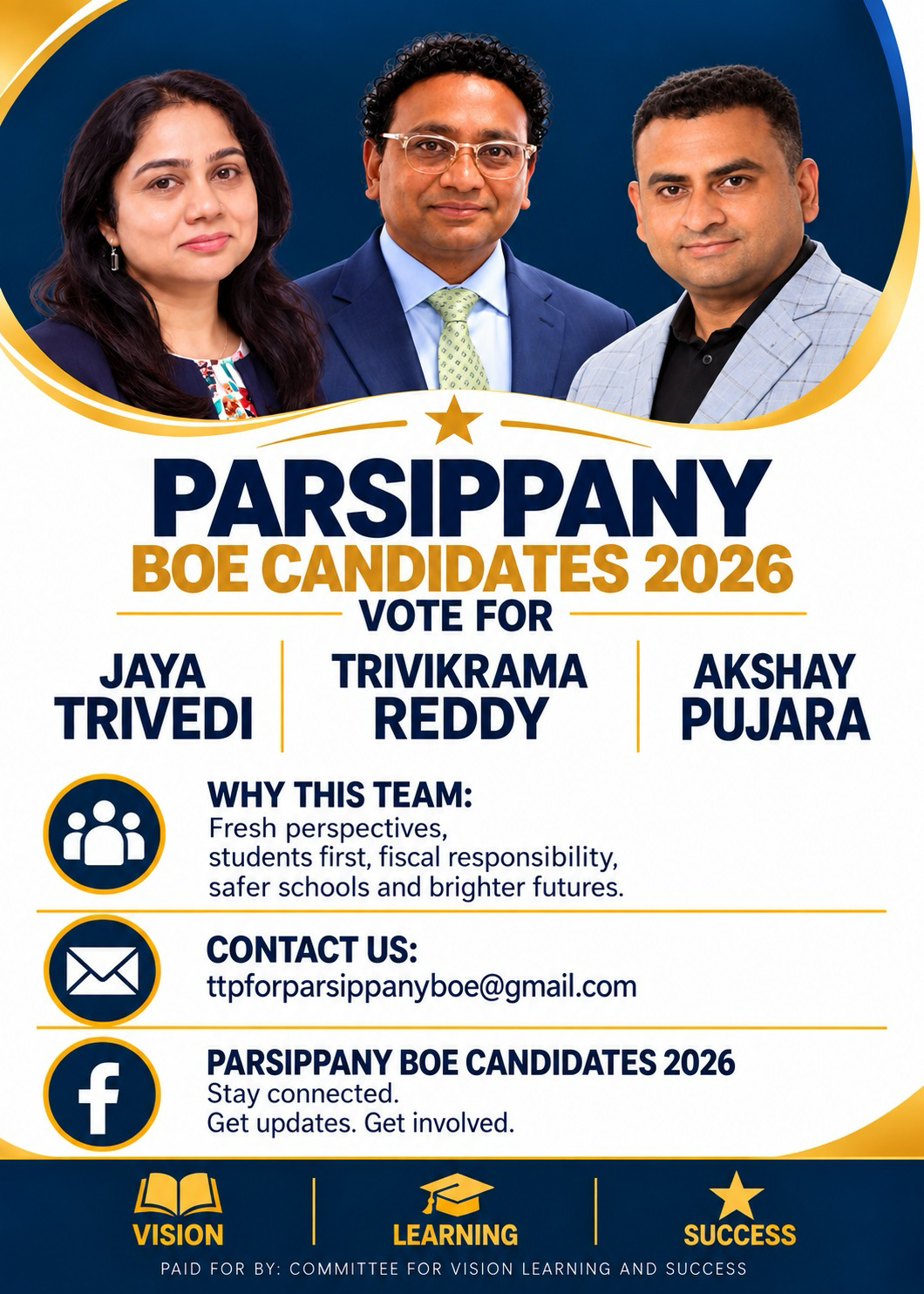
Parsippany Focus submitted identical questions to each Parsippany Board of Education candidate. We print all answers verbatim.
1. Board Meeting Attendance
How many Parsippany Board of Education meetings have you attended in person during the past 12 months? What have you learned from attending?
I have attended every board meeting in the past year, in person. During my first term as a board member, I have learned a great deal about how the Board can best provide appropriate oversight, while also learning a great deal about the operations of the district. Especially in the past year, with the start of Dr. Chase’s tenure in October 2025, I’ve learned how different leadership styles and strengths can create new opportunities for improvement in the district.
2. Understanding the Role
What is the difference between governing the school district and running it? What are three things that should be handled by the superintendent or administration rather than individual Board members?
The Board’s role is to take a “balcony-level” approach to oversight, while also performing core functions like setting policy, approving curriculum, and evaluating the superintendent. Three things that are appropriately the responsibility of the superintendent and administration are: managing personnel below the superintendent level, communication on behalf of the district, and delivering the curriculum.
3. Three Changes
What are three changes or improvements you would like to see in the district, and why?
I would love to see:
- Programmatic creativity at the elementary level–such as through the creation of a dual-language immersion magnet program. This could enrich curricular offerings while also creating a way to balance out uneven geographic development in the district. A lower enrollment school could host such a program, drawing students voluntarily from elementary zones that are experiencing population stress from new developments.
- Support for diverse student activities, at multiple levels: as students’ interests diversify, programs like Robotics, Model UN, and eSports can be fantastic ways to engage students and allow them to flourish, but our current extracurricular models can end up disadvantaging some great programs.
- A more nuanced, progressive approach to special education services, wherein inclusion and success are more thoughtfully engaged for students of all abilities. As part of this, I would like to see the district incorporate parent input at the programmatic level more intentionally.
4. Budget & Taxes
The district is facing significant financial challenges. What areas of the budget deserve closer review, and what would you protect from cuts?
The entire budget deserves our close attention, but some areas that I think could be opportunities are technology use, grant possibilities, and the ultimate costs of deferred maintenance. I would protect class sizes, as well as currently implemented rich curricular opportunities (such as the STEM, Humanities, and Arts Pathways at the secondary levels), and special education support.
5. Long-Term Planning
What should the Board do now to prepare for future budgets and avoid addressing financial problems one year at a time?
Long-term planning is challenging because, by law and contract, the district cannot budget based on future student projects, but rather who is in the school on census day in any given year. So even when we know what the challenges will be, there is only so much that can be done. One area that is squarely in the district’s control is facilities management. We should be ensuring that we have a deep knowledge of the state of our facilities and specific plans for proactive maintenance and future needs. This will reduce surprise expenses, allowing for better planning.
6. Enrollment & Development
How should the district prepare for changing enrollment and new housing when planning class sizes, staffing, transportation, and school capacity?
The Board has commissioned capacity studies and demographic projections, which inform our approach to providing an effective education. The expansion at Littleton is directly connected to what we have learned from this approach. I think we should also be attentive to the diverse needs of students coming from new housing, as these developments represent new neighborhoods with their own strengths and challenges. As just one, small example, I live very close to the Campus Drive developments and I see that there is not much safe, usable outdoor space for children connected to those buildings, so I can anticipate needing to ensure that children from there have access to playgrounds and fields.
7. PILOTs & Township Cooperation
What role should the Board of Education have in discussions with the Township about new development and PILOT agreements that may affect the schools?
The BOE should continue to ensure that the Township understands how development will affect school costs, and how that will translate to tax burden. When a PILOT is passed, the cut of the pie paid for by the rest of the taxpayers is bigger for the potentially generational length of the agreement. The rest of the town ends up subsidizing the developer’s profits.
8. Student Achievement
How should the Board measure student success? What areas of student achievement or opportunity need more attention?
The Board needs to have a multidimensional view of student success–we need to focus on math and literacy proficiency (and even how proficiency is defined!), as well as whether our students are happy, healthy, confident, and able to chart their path through life. I’d like to see continued emphasis on developing evidence-based measures of success across these fields, which is something I’ve particularly advocated for during my time on the Board.
9. Difficult Decisions
When the Board must make difficult decisions involving taxes, staffing, class sizes, programs, or facilities, what information should guide those decisions?
The Board should focus on having the fullest picture of the effects of our decisions. No decision is ever between just A or B–it’s about children, families, livelihoods, and our community. Understanding that complexity, no matter the specific information, is key. Holding ourselves to a high standard of knowledge, empathy, and moral leadership is essential in making difficult decisions.
10. Transparency & Accountability
What information should the district provide so taxpayers can better understand how their money is being spent and what results it is producing?
School funding in New Jersey is astonishingly complex–the more I have learned, the more I have been shocked at how labyrinthine it is. The district should continue to work to educate the public not only as to how our district is spending money, but also how state laws and things like trends in healthcare and inflation affect our fiscal status.
11. Experience & Community Service
What professional experience and community service during the past five years have prepared you to serve on the Board of Education?
I am finishing up my first term as a Board Member, and I think I have demonstrated that I am an effective Board Member by my regular advocacy for evidence-based decision-making, a high-level of engagement, and rigorous training. I earned my New Board Member Certification and upon completing my third year of service, and will have completed all requirements to be a Certified Board Member through the New Jersey School Boards Association.
Further as a career educator, researcher, Girl Scout leader, and parent of a child in the district, I hold many roles that enable me to be an effective representative voice.
12. Three Years From Now
At the end of your three-year term, what specific results would you want residents to use to judge your effectiveness as a Board member?
I hope that residents are, and will be able to see that I have brought a thoughtful, knowledgeable, caring perspective to the Board. Residents can expect that I will continue to advocate for a rigorous curriculum, fair and supportive workplace, and a positive community culture. Residents will be able to see that I have used my knowledge, experience, and voice to advocate on behalf of our students, families, and teacher community.